media overload, living your values, & intentional online consumption
~ A brief guide on how to consume media that aligns with your values

The self care with sky newsletter will be coming to you every other Friday morning (ish). If you haven’t subscribed already, please do! It’s the best free way to support my writing and keep up-to-date on my reflective ramblings and poetry. And if you know someone who could use a pick-me-up, please share this newsletter with them. Cheers!
Dear reader: I found this piece, nearly fully formed, in my Substack drafts. I had completely forgotten writing this back in August 2024. When I re-read it, I was like wow, I really needed to hear this! It’s such a lovely surprise when past me writes something that future me (and hopefully you) can relate to. It’s a bit of a long (and chatty) one, with some psychology nerdiness too, Enjoy!
This time of year, we often spend more time online. Whether that’s shopping for gifts, planning travel, or lounging during our time off, our faces are stuck on our screens.
It’s a beautiful thing, the Internet, but it’s been designed to pressure the consumer to over engage. Our brains aren’t designed to take on this level of use and our mental health is suffering for it.
There are new platforms, old platforms getting facelifts, big-time influencers, micro-influencers, creators, shorts, reels, and newsletters (like you’re reading now). With so much new content, we can easily fall into media overload, a branch of decision fatigue.
Decision fatigue is the feeling of being overwhelmed by too many decisions. This experience isn’t unique to online content; it can happen while shopping, traveling, or even deciding on your coffee order.
The brain science behind decision fatigue is pretty simple: just like an overworked muscle, it stops working as efficiently over time. When we task our brains to process high amounts of information, we effectively overextend our decision-making ability. Thus, mental overwhelm and fatigue.
Also, these apps, websites, and social media platforms are designed to take over our reward system. Ritual use acts like a quick dopamine hit and reinforces on a chemical level that the Internet = feels good. But just like other addictive things, we know that just because it feels good does not mean it’s good for us.
Sometimes, I feel genuinely stressed trying to strategize when to tackle my Watch Later list on YouTube or check my favorite creators. Of course, I want to support these creative, hard-working people. I want to absorb their messages and share what they’re saying.
But sometimes it’s too much—and my offline life can suffer for it.
Love this newsletter? Keep my mind buzzing and my fingers typing by treating me to a coffee! Your support keeps the inspiration flowing — thank you!
It’s so easy to play catch up on my phone at the end of the night versus picking up a book from my TBR or connecting with my partner.
I realize the irony here as I write about this phenomenon in an online newsletter. With that in mind, I graciously thank you for being here and for choosing to give your precious time to my words.
But I always want you to choose your life and your priorities first. My words will be waiting in your inbox whenever you’re ready. Or maybe you never get to it, and that’s okay, too.
So, in my quest to decrease unnecessary stress, I looked at what and how I was consuming media. My daily rotation is usually Instagram, Facebook, Snapchat, and even LinkedIn, each with its own attention-suckers and accounts I want to keep up with.
But then I remembered, the Internet is supposed to add to my life.
Digital content can serve many purposes, such as entertainment, education, branding, socialization etc. At the heart of these are our attempts to connect with our values, what we hold to be important in life. For example, I love reading, so as you can imagine, I follow many book accounts across platforms. But really, I don’t love every account.
If I better understood my values, I could more intentionally consume and let go of accounts that didn’t add anything to my life, or that could be actively hurting my life. Subsequently, living in alignment with my values would enhance my offline life in how I choose to live it.
Cal Newport, author of Digital Minimalism (a fantastic short read that I highly recommend!), says it perfectly:
“Becoming more intentional with your technology use doesn't mean giving it up completely, but rather aligning it with your values and priorities.”
As a therapist, I’ve done a lot of values exercises in my formal training, however I needed a refresh. Our values change over time, and I recently entered my 30th year of life, so I thought some things may have changed from graduate school.
Identifying your values is actually an evidence-based practice used in ACT (Acceptance and Commitment Based Therapy). This therapy says that values are principles that guide how a person wants to act and behave. Bear with me as I briefly put on my nerdy therapist cap:
In ACT, the Choice Point model highlights our two options in any given situation: move toward what matters to us or move away from it (see image below). If we get “hooked” on unhelpful thoughts/feelings, it can lead us to go away from our values. If we effectively “unhook” ourselves from unhelpful thoughts/feelings, it leads us to go toward our values.
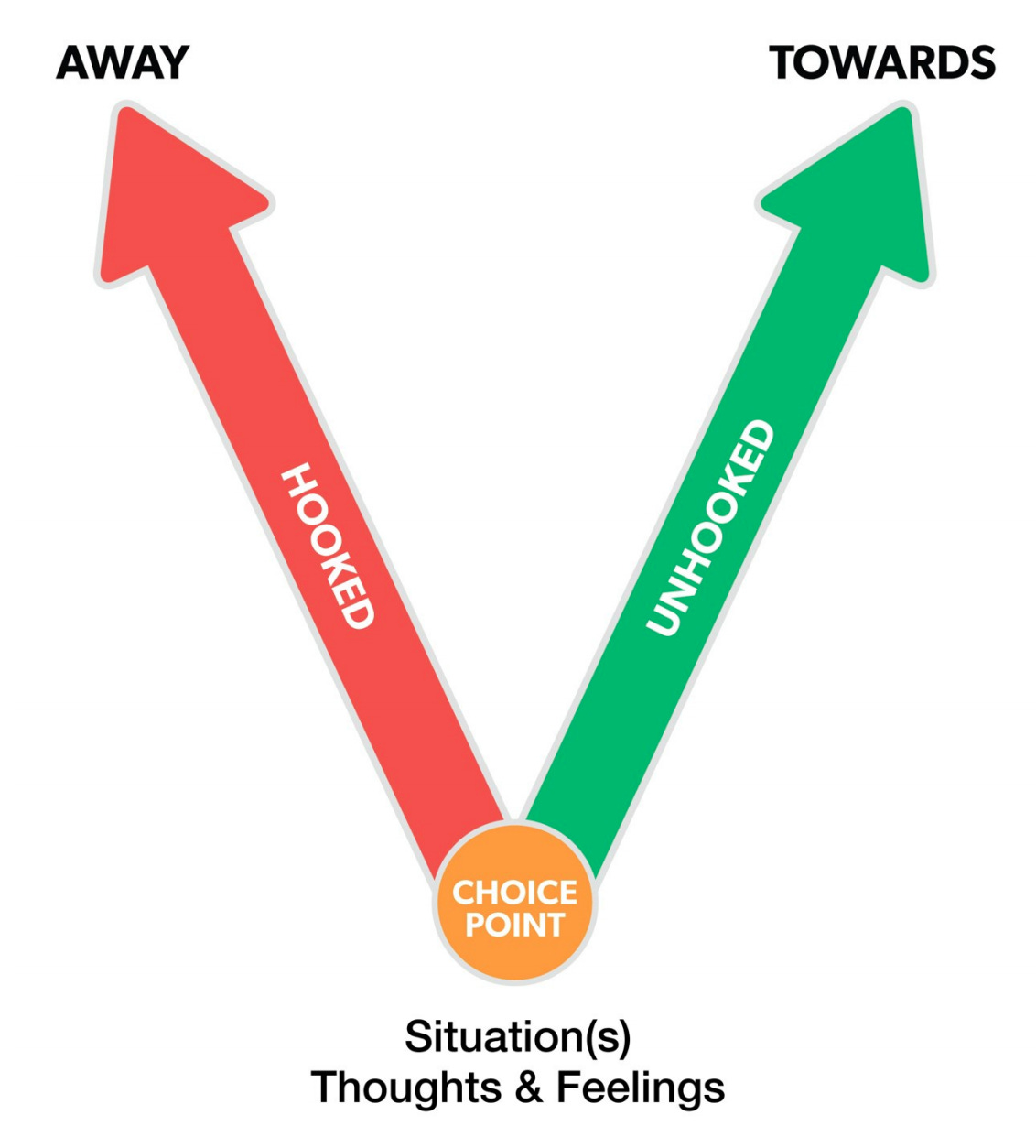
My goal is to “unhook” from the accounts and apps that fundamentally lead me away from my values, be realistic with my day-to-day capacity for being online, and consume only what brings me closer to my values.
A great approachable video for how to find your values is from Morgan Long. Although she's not a therapist, her values exercise in this video is reminiscent of what you might do in an ACT-based therapy session.
From this exercise, my top values were authenticity, groundedness, community, and pleasure. Others were balance, autonomy, stability, contribution, and creativity. With these in mind, I decided to only follow people who also embraced these values.
If you don’t have time to do the exercise, here’s a values list from Brene Brown that Morgan uses in the video.
But I still needed a strategy to ensure I stuck to a heathier way of consuming content.
To get there, I used the following process.
I reflected upon these four key questions:
Does this media align with my core values? And if so, how?
Is this media unique, or can I get it from multiple places? Which feels most helpful to me?
Does this media contribute to my current tastes and informational needs?
Does this media make me feel a certain type of way? (envious, pressure to purchase items, etc.).
And then, I mentally categorized my media into three tiers:
Tier 1: media that directly aligns with my set of values.
Tier 2: media that I enjoy or benefits me in some way but doesn’t particularly fill my cup or add to my life. I call this laundry-folding content.
Tier 3: media I consume on a seasonal or occasional basis, such as around the holidays. Think of YouTube channels that have seasonal gift guides or serve a particular information need at the time, such as gardening or cooking content.
Finally, I fine-tuned my media experience to align with my values:
Tier 1 action steps
I brought this media to the forefront by turning ON notifications, unfollowing similar but mediocre versions of this content, and making this media part of my routines.
Tier 2 action steps
I turned OFF notifications for this media. I continued following accounts but released pressure to keep up with their content. If something catches my eye, cool. But I put no pressure on watching/reading/listening/consuming the whole thing.
Tier 3 action steps
I unfollowed this media entirely and created a running list of what I wanted to check in on periodically such as accounts with good seasonal book hauls or podcasts I only want to listen to during the fall.
~
Whether you adopt this strategy to your own media use or simply reflect more on how it effects you, it’s important to remember that we can’t entirely control our content experience: we are at the mercy of the algorithm and our brain chemistry.
But we can bring intentionality to our online lives, fine-tuning our experience to align with our current values and needs. We cannot consume it all, but when we know our values, these decisions become easier.
Remember, consume with care <3
💜 Where to Find Me 💜
Every post you open and read is immensely appreciated as this newsletter finds its way into the world. If you want to support my work beyond this newsletter, here’s where to start:
My Latest Ramblings:
🌱 TFD Newsletter - Stop Believing Friendship Should Happen Overnight
🌼 Substack (ICYMI) - a (mini) mindful gift guide
💜 Self care nudge 💜
🡪 Do a values exercise! These are the three I use most often with my clients:
💜 Mini What I’m Loving 💜
TV - Very obvious, but I am ON The Stranger Things bandwagon. I can’t wait for the next installment!
Books - At both a client’s and friend’s recommendation, I’m diving in to a new fantasy series. The first book is called, Quicksilver, and the second, that recently came out, is called Brimstone. It’s giving ACOTAR vibes and I’m here for it.
Food - Adult lunchables have been a food prep savior. Cheese and crackers, cut up veg, fruit to mix with yogurt and nuts/chia seeds, and a boiled egg. Simple and effective.
With comfort & care,
sky
Skylar is a licensed clinical mental health counselor who talks about self-care as the foundation of a prosperous life. She has a deep love for all things cozy, vegetarian cooking, and religiously organizing her google calendar. Follow her on Instagram for more self-care inspo (and unsolicited photos of her cats), or on LinkedIn for the more ~professional~ stuff.